AI is no longer a "bonus" feature inside creative tools: in 2026, it is the tool. Editing a video, producing a slide deck, generating a voice-over, running a model on your own machine — every category has its winners, its licensing traps and its quiet price hikes. Here is the cross-category comparison, figures verified on July 3, 2026, with a top 3 per category and a one-page state-of-the-art recap at the end.
Prices and licences verified in early July 2026, against official pages whenever possible. SaaS pricing moves fast (Descript changed its pricing model in September 2025, Adobe has not yet announced post-beta pricing for its AI Assistant): double-check before buying. Benchmarks self-reported by vendors are flagged with an asterisk (*).
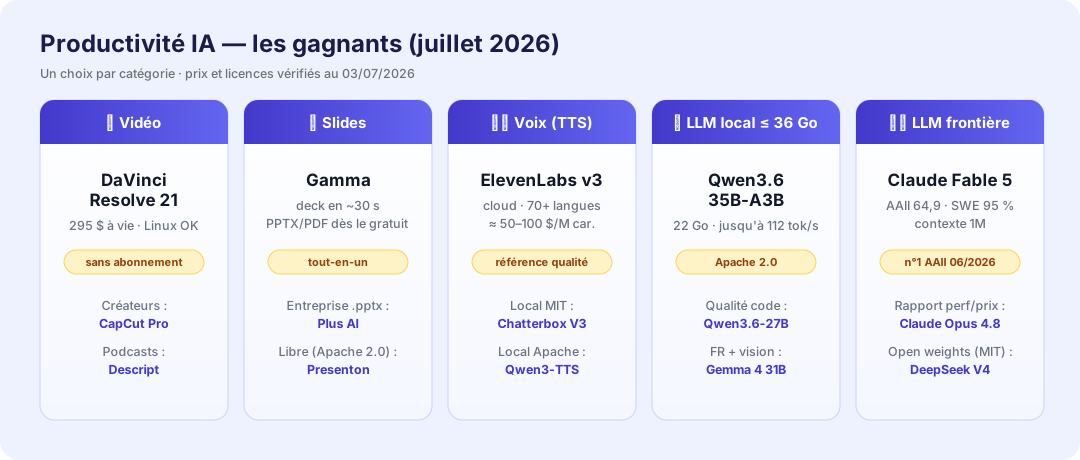 The recap card at a glance — details and justifications below.
Video editing: the agent enters the editing room
This is the 2026 shift: after "text-based" editing, here comes editing by conversation. The category has moved from demos to real products — Descript rebuilt its whole product around its Underlord agent, Adobe put an AI Assistant into public beta inside Premiere Pro (June 18, 2026), and specialised agents like Eddie AI deliver rough cuts ready to open in your editing software. Let's be precise about what is mature: footage logging, first assembly, short clips and cleanup. Fully autonomous "edit this film end to end" remains emergent — the final, creative cut is still human. And we are talking about agents that edit your footage, not "prompt → stock video" generators.
| Tool | The agent, in short | Price (07/2026) | Platforms |
|---|---|---|---|
| Descript (Underlord agent) | chat-driven editing: cut-downs, vertical clips, masked jump cuts, audio cleanup | Free · Creator $24/mo (annual) | Windows, macOS, web |
| Premiere Pro AI Assistant | in-NLE agent: footage logging, bins, multicam sync, first assembly | public beta included · final pricing TBA | Windows, macOS |
| Eddie AI | rough cuts from a natural-language brief, timeline exported to your NLE | pay-as-you-go $15/credit · Pro $167/mo | Windows, macOS |
| Captions (AI Edit) | one-tap "edit my video": cuts, B-roll, captions, music | Free · Pro $9.99/mo | iOS, Android, web |
| Runway (Aleph) | prompt-based editing of an existing shot: objects, angle, light, weather | Free · from $12/mo (credits) | Web (so Linux works) |
| DaVinci Resolve 21 (IntelliScript) | timeline assembled from your script, best takes selected | Studio $295 one-time | Windows, macOS, Linux |
Three profiles, three picks. The spoken-content creator (podcast, YouTube, training) should take Descript: Underlord is the most mature agent on the market — write "cut this down to two minutes but keep the part about X" or "mask my jump cuts with zooms", it plans, executes, and every action stays undoable. The editor already on Premiere should turn on the AI Assistant: footage organisation, multicam sync, markers, first assembly, right inside the project and the undo history — knowing reliability is still uneven and post-beta pricing unknown. The production company should look at Eddie AI: ingest footage in the evening, the agent logs, syncs and builds brief-driven rough cuts, ready to open in Premiere, Resolve or Final Cut in the morning. It is expensive, but it is the only one of the trio built for the pro pipeline.
- Descript (Underlord) — the most mature agent: chat + text-based editing, from $24/mo.
- Premiere Pro AI Assistant — agentic editing inside the reference NLE, free public beta.
- Eddie AI — the pros' assistant editor: rough cuts delivered straight into your NLE.
Apart: Runway Aleph (generative, prompt-based editing of a single shot) and DaVinci Resolve 21 IntelliScript (script-driven rough cut — $295 for life, no subscription, no credits).
Presentations: from prompt to PPTX… everywhere, Linux included
Generating a full deck from a prompt is now table stakes — the real 2026 topic is portability: what is a deck worth if it won't open on your client's machine? Two facts structure the category. First, every serious SaaS exports PPTX, with varying fidelity (fonts, gradients, animations). Second, no AI SaaS exports ODP natively: the OpenDocument format requires going through Google Slides (File → Download → ODP) or through LibreOffice/OnlyOffice, which write it natively.
Tome, the generative-deck pioneer (a claimed 20M users), shut down on April 30, 2025 — decks that hadn't been exported were permanently deleted. The moral: whatever SaaS you pick, export what matters to PPTX/PDF.
| Tool | Type | AI generation | Exports | Price (07/2026) |
|---|---|---|---|---|
| Gamma | SaaS (web) | full deck in ~30 s | PPTX, PDF, PNG, Google Slides — from the free plan | Free (400 credits) · Plus $9 · Pro ~$18–25/mo |
| Plus AI | Slides/PowerPoint add-in | inside the host app | native PPTX; ODP via Google Slides | from $10/mo |
| Presenton | open source (Apache 2.0), Docker/desktop | prompt → deck, your choice of LLM (local Ollama, OpenAI, Claude…) | editable PPTX, PDF | Free self-hosted |
| Presentations.ai | SaaS (web) | business decks | high-fidelity PPTX, PDF | Free · Pro $20/mo |
| Beautiful.ai | SaaS (web) | Smart Slides (auto design) | PPTX, PDF — no free plan | from $12/mo (annual) |
| OnlyOffice / LibreOffice | free software, desktop | in-editor assistants (AI plugin, Ollama possible) | native PPTX + ODP + PDF | Free |
Gamma remains the best all-rounder: the most polished first draft on the market, exports available even on the free tier — but converting its web-native "cards" to classic 16
needs cleanup, and the 400 free credits never renew. For a company that lives in PowerPoint, Plus AI wins by construction: it works inside Google Slides or PowerPoint, so the output file is natively clean — and it's the only near-direct path to ODP. On the open-source side, Presenton is the genuine surprise: Apache 2.0, desktop apps for Windows/macOS/Linux or Docker, fully editable PPTX, and any LLM you like — including 100% local via Ollama for full confidentiality. Finally, if native ODP is non-negotiable, OnlyOffice and LibreOffice Impress remain the only ones writing it directly, with in-editor AI assistants (OnlyOffice's plugin accepts a local model) rather than full deck generation.- Gamma — the all-rounder: best first draft, PPTX/PDF exports from the free tier.
- Plus AI — the enterprise pick: native PPTX with zero conversion, ODP path via Google Slides, $10/mo.
- Presenton — the open-source pick: Apache 2.0, Linux/macOS/Windows, local LLM support, editable PPTX.
Text-to-speech: premium cloud vs. free local
Two worlds coexist: cloud APIs, which dominate on expressiveness, and open-source models that have become genuinely production-ready locally — they all run effortlessly on a recent computer; the podium's largest model weighs 1.7 billion parameters. No four-figure GPU required.
Paid (APIs)
| Service | Edge | French | Price ≈ / M characters |
|---|---|---|---|
| ElevenLabs (Eleven v3) | 70+ languages, emotional "audio tags", cloning | excellent | $50–100 |
| OpenAI gpt-4o-mini-tts | prompt steering, floor pricing (~$0.015/min) | decent | $12–15 |
| Cartesia Sonic-3.5 | 40–90 ms latency (real-time voice agents) | native (42 languages) | ~$38 |
| Hume Octave 2 | contextual emotion (the text is "understood") | yes (11+ languages) | ~$50 |
Local (open source)
Check the licence of the weights, not the code. F5-TTS: MIT code but CC-BY-NC weights → no commercial use. Fish Speech / OpenAudio S1-mini: CC-BY-NC-SA. XTTS-v2: non-commercial licence and Coqui shut down in 2024 — there is nobody left to sell you a licence. All three are excellent, and all three are off-limits for a product.
| Model | Size | Licence | French | Voice cloning |
|---|---|---|---|---|
| Chatterbox Multilingual V3 (Resemble) | 0.5B | MIT | 23 languages, FR included | from 5 s of audio |
| Qwen3-TTS 1.7B (Alibaba, 01/2026) | 1.7B (MLX ports) | Apache 2.0 | native (10 languages) | 3 s + prompt-based "voice design" |
| Kokoro-82M | 82M (~350 MB!) | Apache 2.0 | 1 voice only, B− quality | no |
| Orpheus 3B | 3B (GGUF) | Apache 2.0 | FR as a research release | yes |
| NeuTTS Air (Neuphonic) | 748M | Apache 2.0 | yes (EN stronger) | 3 s |
Chatterbox V3 ticks every box: MIT (the only top-tier model truly free for commercial use), 23 languages, zero-shot cloning from 5 seconds, a unique open-source "emotion exaggeration" control — plus a built-in neural watermark, a welcome ethical touch. Qwen3-TTS, released in January 2026, is technically the most complete (3-second cloning, natural-language voice design, streaming, MLX ports for Apple Silicon) with only six months of community track record. Kokoro remains the fascinating outsider: 82M parameters, faster than real time on CPU — perfect for a lean automated pipeline, as long as the single French voice is enough.
Paid: 1. ElevenLabs v3 (quality reference) · 2. OpenAI gpt-4o-mini-tts (~7× cheaper) · 3. Cartesia Sonic-3.5 (real time). Open source, local: 1. Chatterbox Multilingual V3 (MIT + FR + cloning) · 2. Qwen3-TTS 1.7B (most complete) · 3. Kokoro-82M (tiny, real time on CPU).
Local LLMs: what to run under 36 GB
Let's set expectations first: the open-weights stars of 2026 (DeepSeek V4, GLM-5.2, Kimi K2.6) weigh 300 to 750 billion parameters — out of budget for a personal machine. Under 36 GB of memory (unified RAM or GPU VRAM), the competition happens between 20–35B models, with a simple trade-off: MoE models (few active parameters) favour speed, dense ones favour raw quality. Mind the Mistral Small 4 trap: despite the name it's a 119B MoE — about 60 GB at 4-bit, it does not fit.
| Model | Params (active) | Q4 ≈ | Indicative speed | Strength |
|---|---|---|---|---|
| Qwen3.6-35B-A3B | 35B (3B) | 22 GB (Q6: 29 GB) | 35–50 tok/s, up to ~112 with MLX | the generalist: quality + speed + 262K context |
| Qwen3.6-27B (dense) | 27B | 17 GB (Q8 possible) | 10–25 tok/s | quality ceiling: SWE-bench 77.2*, GPQA-D 87.8* |
| Gemma 4 31B | 31B | 20 GB | 8–25 tok/s (×3 with MTP) | 140+ languages, vision, now Apache 2.0 |
| gpt-oss-20b | 21B (3.6B) | 12 GB | 150–170 tok/s | speed and tool use; collapses at 128K context |
| Magistral Small 1.2 | 24B | 14–15 GB | ~20 tok/s | reasoning + vision + very good French |
* Self-reported by Alibaba — the "a dense 27B beats a 397B MoE at coding" claim has no solid independent verification yet.
On the runtime side, 2026 reshuffled the deck: Ollama now uses MLX as its backend on Apple Silicon (since 0.19, March 2026), and both LM Studio and llama.cpp shipped MTP speculative decoding — up to three times faster on Gemma 4.
# Ollama ≥ 0.19 (MLX backend on Apple Silicon)
# Pulling straight from Hugging Face avoids guessing tags:
ollama run hf.co/unsloth/Qwen3.6-35B-A3B-GGUF:Q4_K_M   # ~22 GB — the generalist
ollama run gpt-oss:20b # ~12 GB — 150+ tok/s, agentsCompared with 24 GB setups, you don't just gain "a bigger model": you can serve 20–27B models at Q6/Q8 instead of Q4 — higher quantization quality on the same model, often a better deal than a bigger model poorly quantized.
- Qwen3.6-35B-A3B — the default pick: Apache 2.0, fast (MoE), 262K context.
- Qwen3.6-27B — maximum quality for code and reasoning, when latency isn't critical.
- Gemma 4 31B — the multilingual/multimodal pick: 140+ languages (excellent French), vision, MTP.
Mentions: gpt-oss-20b as an ultra-fast agent engine; Magistral Small 1.2 for French-language reasoning with vision.
The top 10 LLMs, all categories — July 2026
The first half of 2026 was uniquely dense: five flagship models from Anthropic in six months, six weeks between GPT-5.4 and GPT-5.5, and Chinese open-weights joining the frontier on code. Composite ranking (Artificial Analysis Intelligence Index, June 2026, plus Arena and SWE-bench Verified/Pro):
| # | Model | Vendor | Licence | Context | API price ($/M in/out) | Signature |
|---|---|---|---|---|---|---|
| 1 | Claude Fable 5 / Mythos 5 | Anthropic | proprietary | 1M | 10 / 50 | AAII 64.9 (record); SWE-bench 95% |
| 2 | Claude Opus 4.8 | Anthropic | proprietary | 1M | 5 / 25 | #1 Arena; best frontier reliability/price ratio |
| 3 | GPT-5.5 | OpenAI | proprietary | 1M | 5 / 30 (Pro: 30 / 180) | competition math, agents |
| 4 | Gemini 3.1 Pro | proprietary | 1M | 2 / 12 | GPQA Diamond 94.3%; factuality | |
| 5 | Qwen 3.7 Max | Alibaba | proprietary (API) | 1M | 2.50 / 7.50 | best intelligence-per-dollar |
| 6 | DeepSeek V4 | DeepSeek | open weights (MIT) | 1M | 0.44 / 0.87 | SWE-bench 80.6% at ~5% of closed-model prices |
| 7 | GLM-5.2 | Zhipu AI | open weights (MIT) | 1M | — | #1 SWE-bench Pro (62.1)* |
| 8 | Kimi K2.6 | Moonshot | open weights | 256K | 0.60 / 2.50 | tool-assisted HLE 54%; agents |
| 9 | MiniMax M3 | MiniMax | open weights announced* | 1M | ~5–10% of GPT-5.5 | low-cost multi-actor agents |
| 10 | Grok 4.3 | xAI | proprietary | 256K | ~1.25 / 2.50 | cheap real-time agents |
* GLM-5.2 and MiniMax M3 scores are self-reported, without consolidated independent verification in early July; the actual publication of M3's weights was still to be confirmed. (And yes, in full transparency: the #1 model in this table helped write this article — the numbers come from independent leaderboards, not from us.)
Four underlying trends sum up the semester. One: the frontier is now decided on agentic benchmarks (SWE-bench Pro, Terminal-Bench 2.1, GDPval) — GPQA is saturated above 94%. Two: prices have forked — "GPT-4-class" now costs under $1/M tokens while the frontier premium climbs (GPT-5.5 Pro at 30/180). Three: frontier open-weights are almost exclusively Chinese (DeepSeek, Zhipu, Moonshot, MiniMax, Qwen) — to the point that the US NIST officially evaluates them; Meta pivoted to proprietary (Muse Spark) and Mistral remains the only Western open flagship. Four: 1M context is now the top-10 standard — only Kimi stays at 256K.
The recap card — the state of the art on one page
| Need | The pick | The alternative | The open option |
|---|---|---|---|
| Have an agent edit your video | Descript (Underlord) | Premiere AI Assistant (beta) · Eddie AI (pro) | Resolve 21 IntelliScript (no subscription) |
| Generate slides | Gamma | Plus AI (enterprise .pptx) | Presenton (Apache 2.0) |
| Cloud voice-over | ElevenLabs v3 | OpenAI gpt-4o-mini-tts (budget) · Cartesia (real time) | — |
| Local voice-over | Chatterbox Multilingual V3 (MIT) | Qwen3-TTS 1.7B | Kokoro-82M (real time on CPU) |
| Local LLM ≤ 36 GB | Qwen3.6-35B-A3B | Qwen3.6-27B (quality) · Gemma 4 31B (FR, vision) | all Apache 2.0 |
| Frontier LLM (API) | Claude Fable 5 · Opus 4.8 (perf/price) | GPT-5.5 · Gemini 3.1 Pro | DeepSeek V4 (MIT) |
Three reflexes before pulling out the credit card: read the licence of the weights (not the code), convert "credits" into real cost at your monthly volume, and always export your content to an open format — Tome reminded everyone in 2025 that SaaS products die too.